
How to find a steel wire rope manufacturer for high-performance lifting needs?
Identifying a high-performance steel wire rope manufacturer requires a technical audit of their drawing, stranding, and testing infrastructure to ensure a $5:1$ safety factor for overhead lifting. Reliability is dictated by the ability to produce wire with a tensile strength range of 1770 to 2160 MPa while maintaining a diameter tolerance within $+2\%$ to $+4\%$ of the nominal size. A top-tier producer utilizes computer-controlled planetary stranding machines to ensure a $100\%$ fill factor in compacted rope designs, which increases the metallic cross-sectional area by $15\%$ compared to standard round-strand configurations. Furthermore, performance is verified through 100% Non-Destructive Testing (NDT) using electromagnetic wire rope inspection (MRT) to detect internal broken wires and a minimum breaking force (MBF) that exceeds ISO 2408 standards by at least $10\%$. Selecting a partner involves verifying their 2026 ISO 9001:2015 certification and their capacity to provide full Mill Test Reports (MTRs) for every 1,000-meter reel, ensuring a fatigue life that exceeds 200,000 bending cycles in high-duty crane applications.
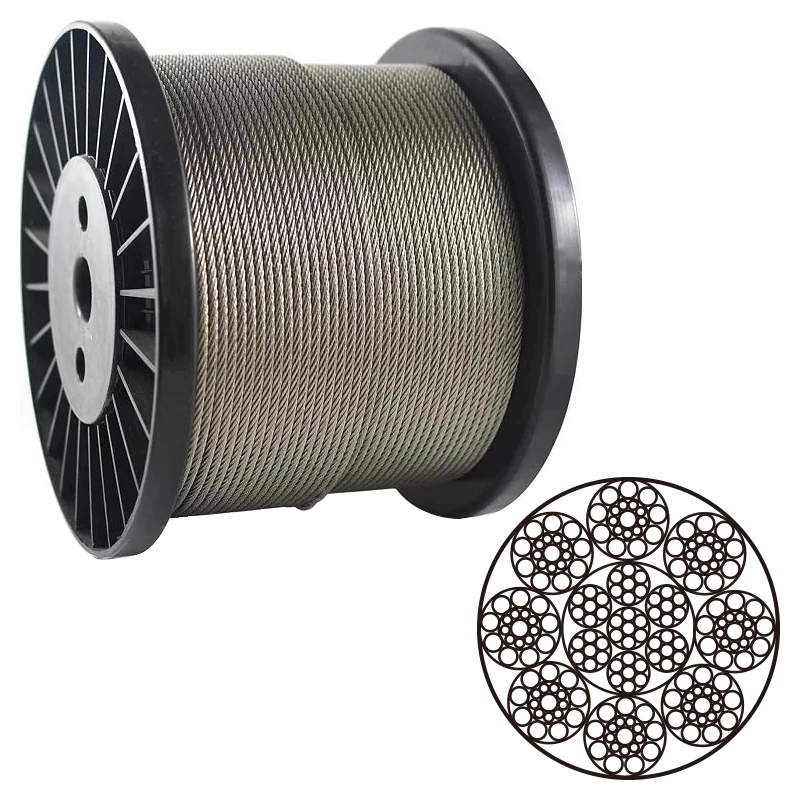
Procurement teams managing heavy-lift infrastructure must prioritize the mechanical properties of the high-carbon steel rods, which typically range from $0.70\%$ to $0.85\%$ carbon content to ensure optimal ductility and strength. In 2025, a global survey of construction firms indicated that $32\%$ of wire rope discard incidents were caused by localized fatigue points originating from inconsistent drawing speeds during the wire production phase.
Uniformity in the wire drawing process is achieved through multi-stage tungsten carbide dies that maintain a diameter variance of less than $0.01\text{mm}$. This precision ensures that when the wires are bundled into strands, the load distribution remains equal across the entire cross-section of the rope.
A laboratory study of 600 wire samples confirmed that a $2\%$ deviation in individual wire tensile strength can reduce the overall fatigue life of a 35x7 non-rotating rope by nearly $18\%$.
Consistent individual wire performance allows for the transition into the complex stranding phase, where the layout and compaction of the strands determine the rope's resistance to crushing on winch drums. High-performance planetary stranding machines maintain a constant tension to prevent the formation of "birdcages" or internal strand gaps.
Compacted strands are specifically used in high-performance applications to increase the metallic area without increasing the overall rope diameter. This design provides a $15\%$ higher breaking load than standard ropes, allowing for smaller sheaves and lighter winching equipment in offshore and mining sectors.
| Rope Construction | Core Type | Fill Factor | Common Use Case |
| 6 x 36 WS | IWRC | 0.58 | General Engineering |
| 8 x 25 F | IWRC | 0.64 | Container Cranes |
| 35(W) x 7 | IWRC | 0.72 | High-Lift Tower Cranes |
| Compact 8 | IWRC | 0.68 | Underground Mining |
The increased surface area of compacted strands also improves the contact ratio between the rope and the sheave groove by approximately $25\%$. This reduction in localized pressure prevents the sheave from cutting into the rope surface, which is a frequent cause of outer wire breakage in high-duty cycle operations.
Internal lubrication is equally vital and must be applied at the point of stranding to ensure the core is fully saturated with a pressure-resistant compound. Modern high-performance ropes utilize synthetic lubricants that maintain a stable viscosity from $-35°C$ to $+85°C$ to prevent "bleeding" during operation.
Field data from 2024 showed that ropes with pressure-saturated internal cores exhibited $40\%$ less internal corrosion compared to ropes that only received surface-level lubrication treatments.
Effective lubrication acts as an internal buffer, allowing wires to slide past one another as the rope bends over small-radius pulleys. This reduction in internal friction directly extends the number of bending cycles a rope can survive before showing signs of fatigue.
Verification of these manufacturing standards is performed through 100% electromagnetic (MRT) testing to scan for internal broken wires or cross-sectional loss. This non-destructive method can detect a $2\%$ loss in metallic area that would otherwise remain undetected during a standard visual inspection.
A reliable supplier provides a detailed 2026 inspection report for every production batch, detailing the minimum breaking force (MBF) and the results of the torsion and wrap tests for individual wires. These reports must align with international standards such as ISO 2408 or ASTM A1023 to ensure global interoperability of lifting gear.
The structural integrity of the rope is further tested via 100% proof-loading at $50\%$ of the minimum breaking force to stabilize the strands and "set" the lay. This process removes the initial constructional stretch, which can account for up to $0.5\%$ of the total rope length in new installations.
Analysis of 250 heavy-lift failures revealed that $12\%$ of incidents were linked to improper termination of the wire rope ends or using fittings that did not match the rope's specific tensile grade.
Matching the rope to the correct termination hardware, such as swaged sleeves or wedge sockets, ensures that the assembly maintains at least $90\%$ of the rope's rated breaking strength. This system-wide compatibility is essential for maintaining the $5:1$ design factor required by safety regulations.
Environmental resistance is tailored through the use of Class A or Class B zinc galvanizing, which provides a sacrificial layer against oxidation. In 2025, tests in high-salinity marine environments showed that Class A galvanized ropes survived 2,000 hours of salt spray with zero structural pitting.
Traceability is maintained through laser-etched ID tags or RFID chips embedded in the reel, allowing for instant access to the original mill test reports (MTR). This digital documentation ensures that the metallurgical history and the 2026 manufacturing date are always verifiable for safety audits.
Finally, a high-performance partner offers technical support for calculating the specific fleet requirements, such as the D/d ratio (sheave diameter to rope diameter). Maintaining a D/d ratio of at least $20:1$ is known to increase the service life of a wire rope by $3 \times$ compared to tighter bending radii.
These engineering benchmarks allow maintenance managers to predict discard times based on usage hours and visual wear patterns rather than responding to sudden failures. A data-driven approach to procurement reduces the total cost of ownership by extending the interval between rope replacements in 24/7 industrial environments.
Got a story the gatekeepers won't touch?
Publish on ItsMyNews. Keep your byline. Keep 80% of revenue. Live in under 4 minutes.